Monday, July 30, 2007

More from the White Swan

We’re about an hour away from late check-out, and three hours away from saying goodbye to the White Swan, and six hours away from saying goodbye to China. It’s hard to believe that we started our Xiamen Adventure just 157 days ago and it is about to end. The White Swan and Shamian Island are a pleasant end-note, so calm compared to most of the rest of China. We’ve had a lovely 19th story room with a fantastic view of the Pearl River and the Guangzhou skyline.
Our last day has been a lazy one. We stayed up late last night and slept late this morning. It was almost 10 a.m. before we even left the room, and we only made it as far as the Swan Room. The girls played and I sat on the red couch and read. A little before lunch time we sallied forth for some shopping, and then headed to Cow and Bridge, a wonderful Thai restaurant. The girls especially liked their special lemonades, complete with flowers.

We came back to the hotel after lunch, and have been resting in our room. I’m about to repack our one open suitcase – should be a challenge with the extra shopping we’ve done! We really haven’t bought much, but we don’t have much room to spare in our luggage.

We’ll check out at 4, and spend a few hours in the playroom, grab a quick dinner at the White Swan deli, and catch the 6 p.m. shuttle to the airport. Our flight leaves at 9 p.m., and in the words of the old travelogue newsreels, we’ll say goodbye to China, land of contrast and adventure!

Next you hear from us, we’ll be back in the U.S.A.!

We're at the White Swan


We made it to Guangzhou! The first leg of our homeward journey is complete.

I woke up at the crack of dawn this morning; actually, I'm not sure I slept at all! My mind was full of all the final details of getting moved out. The girls got up around 7, but were too excited to eat much breakfast. We ended up heading downstairs at 8:45 for our 12:10 p.m. flight! I wanted to give us plenty of time to convince the porters-who-do-not-port to carry down our luggage. I also expected to have to go get a taxi at South Gate to come to the guesthouse to get our luggage. Instead, the head housekeeper ran to get the taxi. We managed to stuff our huge suitcases into one cab by putting the smaller bags in the rear window and one of the large bags on the back seat. The girls were then squished into a corner of the backseat with their backpacks, and I rode in the front seat with mine. It was actually easier than I thought it would be!

This time at the airport I managed NOT to trip over the curb -- it probably helped that Zoe kept reminding me to be careful! When we checked in our bags, we were overweight, which surprised me not. I have no idea if we were overweight when we flew from Guangzhou to Xiamen back in February since we flew with 5 Xiada professors who had attended the Fulbright orientation and the airline averages the weight among many travelers traveling together. We were 23 kilos overweight this time, which cost us a whopping 230 yuan ($30). It cost me almost $100 when I was 6 pounds overweight on the American flight from DFW to LAX. I'm not looking forward to checking in for that leg of the trip -- I doubt that our luggage will get any lighter while we're here!

We were so early for the flight that the girls had time to play in the ball pit at Xiamen Airport again. They had a blast, and I got to sit and recover from a busy morning. Whew!

The girls can easily manage their rolling carry-ons and backpacks in the airport. And they can easily manage them when going from the airport to the airplane on a jetway. But riding a bus and going up a metal staircase -- not so much! Zoe handled it like a trouper, and I ended up putting Maya's backpack in my roller and carrying her roller together with mine. A kindly traveler ended up helping Zoe with her luggage on the stairs -- the same man who bullied two women to scoot over in their seats on the bus so Zoe and Maya could sit down!

Our plane sat on the runway for an hour waiting for permission to take off -- I'm not sure what the problem was. But of course the pilot wouldn't turn the airconditioning on. People were complaining left and right (even without understanding Chinese I knew what they were complaining about!). The flight attendants started passing around glasses of water with actual ICE CUBES in them! I've never seen such a thing in China! Usually they're foisting glasses of boiling water or tea at you, insisting that drinking hot drinks make you feel cooler. Hah!

I keep forgetting how big the new Guangzhou Airport is -- we walked a mile to get our luggage! We had no trouble retreiving our bags and getting a cab to the White Swan, though the security guys in charge of the taxi stand kept saying the bags wouldn't fit and it would cost 300 yuan for a taxi to take that many bags. I kept pointing to the sign near the stand that says clearly in English that a cabbie can't refuse a fare and can't negotiate for an off-meter price. Sure enough, all the bags fit in one cab and the meter put it at just under 100 yuan to the White Swan. We checked in just in time to see a group of adoptive parents with their newly-adopted Chinese babies all gussied up for their "red couch photo!" (For the uninitiated, it's a tradition in Chinese adoption to have a photo taken of all the babies on a certain red couch at the White Swan). Zoe kept asking why they were all dressed up, and Maya kept cooing, "They're so cuuuuuute!"

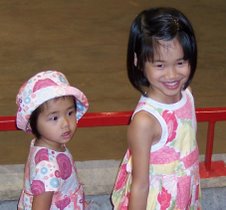
We did a little shopping this afternoon, and then hit the Swan Room, the play room in the White Swan for the benefit of all the adoptive families staying there. We played there in February when we were in Guangzhou for orientation, and the girls were panting to play there again (that's where Maya is in the picture above). We then went to Lucy's, a nearby restaurant beloved of adoptive families, for dinner. The girls had a bath and I'm about to do the same -- the White Swan bathtubs are soooo deep and I remember taking a bath in them at each adoption trip and finally feeling clean after a week's worth of the world's quickest showers (new mothers know what I'm talking about!).

We've arranged for late checkout since our flight doesn't leave until late. So tomorrow we'll enjoy the parks and statues on Shamian Island, do a little shopping, play a lot in the Swan Room, and then head for the airport for the next-to-last leg of the trip home.

Sunday, July 29, 2007

Last Days in Xiamen

We’ve been busy, busy, busy since returning from Xi’an. I’m really glad we went, but it has made the last few days of getting ready to leave completely crazy. We’ve had to pack up all the things we’re leaving behind (the stuff that was here when we got here, plus everything we bought to make our stay more comfortable but are too big to take home) AND the things we’re taking with us. And we’ve been saying goodbye to friends.

Friday evening Chen Xing (Maya’s classmate) and her family came over to bring us some gifts, and to take away some of the things we didn’t want to take home – some clothes Zoe has outgrown, some toys, all of the English-language workbooks we brought and didn’t use (!). They were also nice enough to take foodstuffs – bottles of soy sauce, oyster sauce, garlic juice, sesame oil – that we couldn’t take home. I hate waste, so I’m glad they said they could use it.

Before we left for Xi’an I got a call from one of the parents in Zoe’s class. She said all the parents wanted to thank me for the English lessons and for putting together the English teaching materials to send home with the kids for the summer. They wanted to take us out to dinner Saturday night. I said that would be lovely.

Little did I know that it was going to be a HUGE party, with all 3 teachers and about 12 families in attendance! (The picture above is from the end of the evening and we’d lost some folks by then; the grownups are the three teachers). I think, though, that we were just an excuse for a party. Or maybe it was a little guanxi. Guanxi translates literally as “relationships,” but in China it’s often about doing favors and returning favors. The Chinese business world is built on guanxi, providing gifts and favors for business associates, government officials, those you hope to do business with. You’ll often hear Chinese people use the English expression, “You scratch my back, I’ll scratch yours,” to explain guanxi. It’s not quite bribery, but it sometimes looks mighty close! I detected a little sense that the parents felt they owed me payback. But who cares? It was fun, and the girls had a great time!

We were picked up by one of the families and taken to a hotel with a huge buffet restaurant. The girls ate practically everything in sight, though they refused to eat a Xiamen specialty – seaworms in gelatin. Because our hostess insisted, believe it or not I ate it! Thank goodness it’s eaten with wasabi and soy sauce, so I couldn’t taste a thing beyond hot, hot, hot. And I didn't actually chew, so the gelatin just kind of slithered down my throat! Remember that old childhood retort, “Eat worms and die!”? Well, now I can say I ate worms and lived to tell about it.
Zoe much preferred the ice cream (can you blame her?).

Maya didn’t care what she ate, she just liked playing and being the pet of all the older kids and grownups.
I admit I had more fun hanging out with the kids than with the grownups – they are easier to talk to when you don’t speak the same language!
I think I’ve mentioned (brag, brag, brag!) that Zoe won a speech contest at Chinese School in Fort Worth for reciting a poem. Well, I’ve been trying to get her to say it to ANYONE here in China and she has adamantly refused. FINALLY, to my amazement, she agreed to say it to her teachers!
The teachers were amazed – they pulled over one of the English-speaking moms to translate their praise. They said she barely spoke a word at school, and they had no idea she knew any Chinese. They also said her pronouciation was excellent, that she got the tones right and everything. (But remember the rest of the story about the speech contest? I asked Zoe what the poem meant and she said, “I don’t know, it was in Chinese!” I’m still not sure she has a clue what she said!) Zoe was pretty proud of herself, and I sure was, too.

Today we went to my office to pack up everything there – not too much since I’m leaving all the books. Walking back to the apartment we stopped at the store to buy “special snacks” for the long plane ride. Mostly we wanted to cash in all of the coins the girls have been collecting in their piggy banks. I was amazed at how much they had – 52 yuan, mostly in 1-jiao coins (10 jiao = 1 yuan)! You can buy a lot of snacks with that!

As we walked home, the girls had a great time saying goodbye to everything – “goodbye, school; goodbye, basketball court; goodbye butterfly leaves; goodbye, beach. . .” you get the idea. Before long, though, the litany of goodbyes degenerated into “goodbye, stinky trash can; goodbye, beggars; goodbye, crazy drivers; goodbye rude people (that would be folks who cut in line, stare at us, pick their noses, etc.!).” Obviously they have their own list of “what I won’t miss about China!”) And just like my list, it’s a way to make themselves feel better about leaving.

Because we have had a wonderful time here. When you ask the girls whether they are happy to be going home, they’ll definitely say yes. But when you ask them if they’d like to come back to China, they say yes, too. And I admit I’m in full agreement – it will be wonderful to get home, and we’ll definitely be back!

Tomorrow morning at 9:00 we head to the airport with our nine pieces of luggage (3 suitcases, 3 carry-ons, 3 backpacks), first stop Guangzhou. We’ll spend the night at the White Swan Hotel, and then take the China Southern night flight, leaving 9:00 p.m. on Tuesday, July 31. We arrive at LAX around 7 p.m. the same day (the international date line is in our favor on the trip home), but don’t leave there until a little after midnight, making it Wednesday, August 1. We’ll arrive at DFW at 5:15 a.m. (poor Cousin Aaron, who has to come pick us up!). Yippee! We’re almost home now . . . .
Xi'an Part IV: The Noodle Maker

Hi, this is Zoe. This is my first blog post. It's been fun living in China, because there are fun things to see all the time, like statues and frogs and dragonflies and the fish at Nanputuo. I loved watching the noodle maker at the restaurant we went to for lunch after seeing the terracotta warriors (which were cool!). My mom let me take pictures, and I picked out the ones I wanted to post to the blog, and helped my mom edit them, and then I told her what to type.

To make the noodles, first the noodle maker cut the dough and put flour on the counter and the noodles. He rolled the dough on the counter to get the flour, then he put oil and water on it. He kneaded it for about 5 minutes and then started to stretch it. He swung it up in the air and banged it down on the counter with a loud boom, and he did that over and over again.
Then he stretched it until it became really long.

The dough got really long and thin, and got thinner and thinner as he kept stretching it. And then it just broke apart into noodles – he didn’t cut it or anything! He flopped it up in the air to separate the noodles, and rolled the long noodles on his fingers.
He put the noodles in a big pot to cook – that’s why the pictures look so steamy. It’s also steamy because soup was cooking, too.
While the noodles cooked, the noodle maker put soup in little bowls.
By then, the noodles were cooked. He stirred the noodles and fished them out with a big net on a stick.
Finally, he put the noodles in the soup bowls.
People were standing in line to get the noodles. I ate some of the noodles, too, and I thought they were good. They were a little spicy, but I still liked them.

It was really fun to watch the noodle maker and to take pictures so I’ll always remember how noodles are made!

Saturday, July 28, 2007

Xi'an Part III: Terracotta Warriors

Sometimes when you’ve been anticipating something for a long time, the reality just doesn’t measure up. NOT SO with the terracotta warriors of Xi’an! They are truly fantastic, actually worthy of the designation “Eighth Wonder of the World.”

We started by seeing a short movie-in-the-round (you stand in the center while the movie shows all around you on a 360-degree screen – very cool!) about the construction of Emperor Qin’s mausoleum and the pits for the terracotta warriors. It seemed that the emperor, reigning around 250 B.C., bankrupted his people with high taxes to pay for it all, and conscripted over 720,000 people to work for him rather than in their own fields with resultant famine and poverty. And what he wasn’t doing to destroy the populace of southern China he was doing in northern China by ordering the construction of the Great Wall. Still, he was a heroic figure in some ways, having joined all the kingdoms of China by defeating all the various warlords warring among themselves. And he managed to keep the kingdom together and repel the Mongolian hordes. But his son was not able to continue the Qin dynasty, being defeated by an uprising of the oppressed peasants. They opened the pits, burned everything in sight, stole the weapons the warriors were carrying, and destroyed many of the statues. Burning the underground structures housing the warriors caused further damage to the statues – they were crushed under the weight of the dirt and wooden beams above them.

The making of the statues must have been quite an undertaking. And I didn’t realize this until now – each statue is inscribed with the name of the craftsman who made it! They’ve identified over 80 different craftsmen. Each statue’s body was made using molds. There were various body types – standing archers, kneeling archers, cavalry soldiers complete with horses (the cavalry soldiers are not seated on the horses because the kilns were not big enough, so they stand beside their horses), infantry soldiers, even high-ranking officers. There were also wooden chariots, now rotted away, manned by more terracotta warriors and pulled by terracotta horses. The detail in the soldiers’ uniforms is incredible, down to the stitching on the soles of the kneeling archers’ shoes and the studs holding together the plates of armor. And it seems that the figures were originally painted quite elaborately, but all traces of color disappear almost as soon as the warriors are unearthed because of oxidation. In fact, the archeologists have decided not to unearth any more warriors until they figure out how to preserve the color. How extraordinary this army must have looked when painted!

The heads were molded, but the faces were not made from molds; each was hand-done and the variety in facial features, hairstyles, head dresses, facial hair and facial expressions is astonishing. The different ethnic minorities in Qin’s empire are represented in those different facial features and hairstyles/head dresses.

The highlight of the museum is the unromantically named “Pit One,” the largest of the pits of excavated soldiers. It is truly enormous, but only represents a fraction of what is believed to be still buried. The warriors were deployed four across in trenches, as you see them here. The earthen walls between them do not contain more soldiers – these were the walls that held up the roof and tons of dirt over the army’s head (the walls were taller then, of course).

What a bizarre and extraordinary undertaking to replicate Emperor Qin’s army so that his soul could continue to rule the kingdom he believed would exist underground after his death. And it wasn’t just the army he recreated in terracotta – they’ve also unearthed pits with statues of acrobats and civil officials. And then there are the birds and animals and stables of horses that were buried alive to populate Qin’s underground kingdom (it seems he liked to hunt, so he made sure to have animals available so he could enjoy this pastime after death). The birds, animals and horses all had terracotta attendants with them. And don’t forget the concubines – the new emperor ordered that those who had no children were to be entombed with the dead Emperor Qin. Also buried alive were thousands of officials and workmen who knew the location of Qin’s tomb, so that they could not reveal that secret.

One of the newest discoveries was bronze chariots and horses, much smaller than the terracotta variety – after all, bronze is more costly than local clay! They are also incredibly detailed, and after the archeologists put together the chariots, they were actually able to move just like the wooden originals would have.
Still, the most amazing things for me were the warriors, rows and rows of them in battle formation, each frozen in time.


Oddly poignant – after all, these are clay figures, not real men – were the broken warriors, some probably beyond repair, others waiting for their turn to be put back together again like so many humpty-dumpties.

At the end of Pit One is what I think of as the “medical ward,” where archeologists are trying to put the warriors back together like jigsaw puzzles. Almost none of the statues were found intact.
Speaking of finding the warriors, most of you probably know that they were rediscovered in 1974 by local farmers digging wells for water. We got to meet one of those farmers – Mr. Yang – who was rewarded for his discovery with the payment of 40 yuan (which he had to share with his collective!). He is now 84 years old, and is no longer an illiterate farmer – he can now sign his name, which is important in his new job. He works in the museum gift shop, selling the official catalog of the terracotta warriors. And he signs each one. Our guide told us that he was a crotchety old fellow who didn’t enjoy his new job much, and that he refused to have his picture taken. Sure enough, when we went to buy the book, there was a sign next to his desk saying “No Photos!” I thought it was pretty funny – there was a couple trying to take his picture by having the woman stand casually with him in the background while the man took a picture. No flies on Mr. Yang, he saw what they were up to and moved his palm fan in front of his face so they couldn’t get a clear shot! Still, he looked us in the eye when he signed the book and smiled at Zoe. So maybe he’s not so crotchety after all!

In between touring the museum, we ate lunch at the museum restaurant. It was OK, but nothing to write home about. Zoe was mesmerized, though, by the noodle-maker, and spent most of the lunch at his counter watching him make the noodles by hand. She took about a million pictures of him at work – I told her she’ll have to write the blog post about that herself. So look for Xi’an Part IV: The Noodle-Maker, coming soon to your local theatre!

The girls were pretty worn out by all the walking – the museum is quite spread out over 5 or so buildings. So as we waited for the rest of our group to gather to leave the museum, they rested in their “houses.”
We spent about 4 hours at the museum, and I don’t think we saw a fraction of what was there. Now I have a new goal – GOING BACK to Xi’an to see more of the terracotta warriors!

Friday, July 27, 2007

Xi'an Part II: The Great Mosque & the Wild Goose Pagoda

We visited two great religions today: Islam and Buddhism. Both came to China from other countries, both came to China very early in its history, and both flourish today. Of course, Buddhism has far outstripped Islam in China. Still, there is a very active Muslim population throughout China.

First we visited a small museum dedicated to “farmer paintings.” These are familiar to me, but I’ve always heard them called peasant paintings. They are brightly colored and usually represent village scenes. Farmer painting is similar, but in the 1950s it flourished in Xi’an as Party propaganda – or as the museum docent told us, the themes were “political.” The paintings would show happy farmers reading Mao’s little red book; even in a painting where there was no overtly political theme, Mao’s little red book could be seen peeking out of a farmer’s breast pocket!

The museum also has traditional Chinese scrolls with Chinese painting and calligraphy. The girls got a chance to try their hands at calligraphy, first learning how to hold the brush.
The teacher told them about the four treasures of Chinese calligraphy – can you identify them in this picture?

They are: 1) the painting brush, 2) rice paper (which is not actually made of rice!), 3) the ink stone (where the ink is mixed), and 4) the ink stick (Chinese ink comes in a stick which is ground into powder and mixed with water to make ink). I love how elaborate things are in China; we have to name these simple instruments "treasures!"

This was also one of the usual “shopping stops” that is included in every tour (tour guides customarily get kickbacks for bringing their groups to these places – some tour companies won’t even pay a salary to their guides, the only money they earn is from these kickbacks and from tips. OCDF does pay a salary, so we’ve not had to do too many of these shopping stops while on their tours). But the opportunity to see the paintings and learn a little about Chinese calligraphy made this one the best disguised “shopping stops” I’ve seen! For most, the “museum” part is so pitiful that they shouldn’t even bother. (The next day we went to a place “to learn about jade,” and they barely tried to pretend it was anything other than an excuse to shop.)
After the museum, we visited the Great Mosque. It was hard to tell that the Great Mosque was actually a mosque, given the very Chinese design of the place. Apparently it was originally an imperial palace, and the Emperor gave permission to use it as a mosque back in the 8th century.

Following through on the Chinese design, even the minaret was a Chinese pagoda!

The prayer hall was recognizably Muslim, with rows of prayer rugs inside. We were not allowed inside, but you can see the Arabic script on this column, and behind the girls are clocks marking the times for the five daily prayers.
There were two old bearded men sitting in front of the prayer hall, and an Arabic-looking woman, with headscarf, and accompanied by a Chinese man came up to the prayer hall. She was speaking English with the man, whom I suppose was a guide or translator. One of the old men asked where she was from, and she said Bahrain. He motioned her to come to the door of the prayer hall, and let her look in. He pointed at something, and proudly said, “Koran.” He seemed pleased to be able to show a “real” Muslim that the Chinese were “real,” too. The mosque is not just an historical site – it is still an active mosque, as you can see by this group of men leaving the mosque after midday prayers.
Muslims in China are ethnically Chinese, having become Muslim from conversion. But it was an Arabic population who came to China and converted them. Not surprisingly, there was a lot of intermarriage, and Chinese Muslims still show traces of that Arabic heritage in their ability to grow beards. We saw more facial hair in one hour in the Muslim quarter than we’ve seen in our 5 months in China! (Of course, having a beard is a religious thing for them, unlike for other Chinese, some of whom can in fact grow facial hair but are likely to shave it.) The Muslims are one of the recognized non-Han minority groups in China, and the one child policy does not apply to them.

After the mosque, we visited the Wild Goose Pagoda, which was built over 1,000 years ago.
Does it look to you like the pagoda is leaning? It is, indeed. It seems that overuse of the water table has caused it to sink slightly, though we were told it didn’t as yet pose structural problems. I guess a little wear and tear is to be expected after 1,000 years!

The history of the pagoda is interesting; it was built at the request of a Buddhist monk who spent 15 years traveling in India and collecting holy books of Buddhism there in the 7th century. When he returned, he asked the Emperor to construct the pagoda to house the books. The pagoda is actually built in the style of Indian temples, and is named Wild Goose Pagoda after a pagoda the monk saw in India. What’s really interesting is that the monk wrote his memoir detailing his travels, and that served as the basis for the famous novel, Journey to the West, written in the 1500s. The fictionalized version of the journey is now much more famous than the factual version, and the girls have been watching the TV version for 5 months! They can tell you everything you ever wanted to know about BaJie (the pig), HuGu (the Monkey King, who also goes by many other names), WuJing (the friar), and XuanZang (the monk traveling to collect scriptures). The first three are the monk’s disciples, and are in charge of protecting him from humans and demons during his journey. There’s both a cartoon version and a live action version, and the girls are mesmerized by both of them.

As you can see from the picture of the girls with the happy Buddha, they had a great time wandering around the pagoda grounds and imitating the statues. Above they are happy, and below they are reverent.

And so ends our first day of sight-seeing in Xi’an. Back at the hotel, the four girls played together, had dinner together, and tried out the swimming pool (it’s an indoor pool and so frigid they lasted less than 10 minutes! I never managed to go in past my knees.)

I enjoyed the Mosque and the Pagoda, but it was only prelude for the REAL reason I came to Xi’an – the terracotta warriors. That will be the next exciting installment!

Xi'an: Part I

We're back home in Xiamen after an uneventful flight -- far less eventful than our experience getting to Xi'an! I managed to take a fantastically ungraceful prat fall while walking into the Xiamen Airport. I tripped on the curb and landed face first on the sidewalk. It was such a spectacular fall that the cab driver who delivered us to the airport actually left her cab in the middle of the street to check on me! I was fine -- but I managed to split my lip with my front teeth and was bleeding like crazy. It was funny, as I was falling I realized I was going to hit my face on the sidewalk even before it happened; that whole falling-in-slow-motion thing is apparently true! Who knew?!

Anyway, I brushed myself off, checked in our luggage, and managed to secure ice for an icepack, which I found pretty amazing (finding ice, I mean)! I feel really lucky that I didn't break anything, and I still have all my teeth. And about one-third of my top lip rivals Angelina Jolie's in puffiness -- I highly recommend collagen injections over my method!

Other than that, getting to Xi'an was a breeze. We checked into our hotel, ate dinner at the hotel's buffet (pronounced by all the hostesses as boo-fey!), and had an early night. The next morning, our friends arrived by the night train from Beijing. That's Maggie and Meredith with Zoe and Maya in the picture above. My girls were really tickled to meet up with their friends from America.

Sue, Maggie & Meredith are on an OCDF tour, like the mini-tour we did with OCDF in June to Guangxi Province. Their tour includes Beijing, Xi'an & Guilin, and then they'll be visiting Meredith's and Maggie's hometowns. We arranged with the OCDF tour guide to join the group for the Xi'an portion of the trip.

We were to meet the group at 11 a.m. for the first outing, and as we walked to the lobby I saw someone who looked familiar. But it couldn't be, could it? I couldn't just run into someone else from the States in China, could I?! Sure enough, the OCDF tour included ANOTHER family I knew! I actually went to college with Melissa. We lost track of each other after I graduated from Rice, but we reestablished contact when she and her husband, Chris, were waiting to adopt Joie from China. They even came to the airport to meet Zoe when she first came home from China! Melissa was just as surprised to see me as I was to see her, and I hope she was just as delighted as I was to see another friendly face in China.

More about our Xi'an adventures in the next exciting installment of "All Roads Lead to China," same Bat-time, same Bat-station . . . .